跳到内容
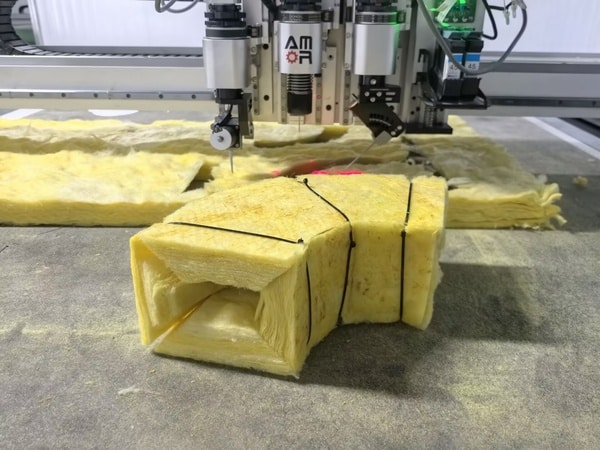
Fiberglass insulation is difficult to cut cleanly. Dust spreads across workshops, workers face more cleanup, and traditional cutting methods can slow down production.
We recommend CNC oscillating knife cutting for many fiberglass insulation and mineral wool applications. Its cold blade cutting method creates a narrow kerf and reduces airborne dust, while CNC automation supports accurate, customized cutting with less manual work.

When insulation manufacturers choose a cutting machine, they often focus on cutting speed, accuracy, and production capacity. However, we believe that dust control and machine protection deserve the same attention. A suitable cutting solution should help manufacturers improve production efficiency while keeping the workshop cleaner and reducing daily maintenance work. In this article, we will compare two cutting methods and explain why we developed additional dust protection for our CNC cutting machines.
Why Does Fiberglass Insulation Create Dust During Cutting?
Fiberglass insulation provides good thermal and acoustic insulation. However, its loose fiber structure can make cutting and handling difficult. Many manufacturers worry about airborne particles and workshop cleanliness.
Fiberglass insulation can release loose fibers during processing. The right cutting method can reduce fiber disturbance and help control dust during production.
What Happens to Fiberglass During Cutting?
Fiberglass insulation contains many fine glass fibers. These fibers form a lightweight structure that provides thermal insulation. When workers cut, handle, or move the material, some loose fibers may separate from the main structure.
The cutting method plays an important role in how much fiber disturbance occurs. A cutting tool that creates excessive friction or breaks more fibers can release additional particles. The material density, thickness, fiber direction, and surface structure can also affect the cutting result.
Why Is Dust Control Important for Insulation Manufacturers?
Dust can create several problems in daily production. Workers may need to spend more time cleaning the worktable and surrounding areas. Loose particles may also collect around machine components and increase maintenance requirements.
We understand that manufacturers do not only care about the final cutting result. They also want a cleaner working environment and a machine that can operate reliably over time.
For this reason, we consider dust reduction an important part of insulation cutting machine design. We focus on both the cutting method and the protection of key machine components.
Traditional Saw Cutting: What Challenges Can Manufacturers Face?
Traditional saw cutting is widely used in many insulation processing applications. However, the cutting process can create friction and disturb the fiber structure, which may increase dust generation.
Traditional saw cutting can be effective for certain production requirements. However, manufacturers should also consider dust generation, cutting kerf, material waste, and maintenance needs.

Does Saw Cutting Generate More Dust?
Traditional saw blades use rotating teeth to cut through materials. These teeth contact the insulation surface and remove material during the cutting process. This action can break fibers and release particles, especially when the blade, speed, or cutting conditions are not suitable for the material.
The amount of dust depends on several factors, including the saw blade design, cutting speed, material density, and thickness. Different machines can produce different results.
We do not consider every saw-cutting application the same. However, we believe that manufacturers should pay close attention to the dust produced during actual production, rather than choosing a machine based only on its cutting speed.
How Does Cutting Kerf Affect Material Waste?
The cutting kerf refers to the width of material removed during cutting. A wider kerf means that more material is lost along each cutting path.
For insulation manufacturers who process large quantities of fiberglass or mineral wool, material utilization can affect production costs. A narrow cutting kerf can help reduce unnecessary material loss, especially when manufacturers need to cut multiple customized shapes from one sheet.
What About Machine Cleaning and Maintenance?
Dust and loose fibers can collect around machine surfaces, guide rails, racks, and other transmission components. This accumulation may increase cleaning work and affect long-term maintenance if manufacturers do not protect these areas properly.
We believe that a cutting machine should not only perform well during the cutting process. Its structure should also consider the actual working conditions in an insulation factory.
Why Do We Recommend CNC Oscillating Knife Cutting for Fiberglass Insulation?
We designed our CNC oscillating knife cutting machines for flexible industrial material processing. The machine uses a reciprocating blade instead of a high-speed rotating saw blade.
Our CNC oscillating knife cutting machine uses cold blade cutting technology. The narrow cutting kerf and direct blade action help reduce fiber disturbance and airborne dust during normal cutting operations.

How Does Cold Blade Cutting Work?
Our oscillating knife uses a blade that moves up and down at high frequency. The blade separates the material through repeated cutting movements. The process does not rely on high-speed rotating saw teeth or abrasive grinding.
This cutting principle offers several advantages for insulation processing.
First, the blade does not need to grind the material during cutting. Second, the narrow kerf reduces the amount of material removed along the cutting path. Third, the cutting action helps reduce unnecessary fiber breakage.
One of the main concerns we hear from customers is airborne dust. We have considered this issue in our cutting solution. Under suitable material and machine settings, our oscillating knife cutting process does not create the visible airborne dust cloud commonly associated with traditional saw cutting.
However, loose fibers may still come from the material itself or from handling. We do not recommend treating any cutting method as a replacement for appropriate workplace cleaning and safety measures.
Why Is a Narrow Cutting Kerf Important?
A narrow cutting kerf is another important advantage of blade cutting.
The blade removes very little material along the cutting path. This helps manufacturers make better use of insulation sheets and reduces unnecessary material waste.
For example, when a factory needs to cut different insulation shapes from one large sheet, a smaller kerf can help optimize the layout. Our CNC software also supports automatic nesting, which helps arrange cutting patterns more efficiently.
The combination of a narrow kerf and automatic nesting can improve material utilization. The actual savings depend on the cutting layout, material size, and production requirements.
Can an Oscillating Knife Handle Customized Cutting Patterns?
Yes. We believe this is one of the most important advantages of CNC oscillating knife cutting.
Traditional cutting methods may require different tools or additional manual operations for different shapes. Our CNC cutting machine can follow programmed cutting paths to process straight lines, curves, irregular contours, and customized patterns.
Manufacturers can import supported design files, such as DXF, into the machine software. The operator can then set the cutting parameters and start the programmed process.
This flexibility is especially useful for insulation manufacturers who produce different sizes and shapes according to customer drawings. The machine can reduce manual marking and repeated measuring work. It can also help manufacturers maintain consistent cutting dimensions across repeated orders.
Why Do Our CNC Cutting Machines Need XY-Axis Dust Covers?
Some customers still worry about dust even after learning about cold blade cutting. We understand this concern because insulation factories work with loose fibers every day.
We added an optional XY-axis dust protection system to help protect important machine components from insulation particles.

Why Did We Develop Additional Dust Protection?
When we designed our insulation cutting solutions, we considered more than the cutting result. We also considered the working environment inside an insulation factory.
Even when the cutting process produces very little airborne dust, some loose fibers may remain on the material surface or become airborne during loading, unloading, and handling.
These particles may enter exposed machine areas over time. Guide rails, racks, and other transmission components need proper protection to reduce direct exposure to dust.
For this reason, our engineering team considered additional protection for both the X-axis and Y-axis.
How Do XY-Axis Dust Covers Work?
The XY-axis dust covers provide a protective barrier around important machine movement areas.
The X-axis and Y-axis guide systems control the movement of the cutting head across the working table. These areas are important for machine accuracy and stable operation.
Our dust cover design helps reduce the amount of insulation dust and loose fibers that directly reach the protected transmission components.
This design also makes routine machine cleaning easier because operators can clean the exposed surfaces without leaving the main transmission areas unprotected.
How Does Dust Protection Help Long-Term Machine Operation?
Machine protection is an important part of long-term production planning.
When dust collects around moving components, operators may need to spend more time cleaning and checking the machine. Proper protection can reduce direct dust exposure and help maintain the condition of important components.
We do not claim that dust covers make a machine completely dustproof. However, we believe that combining low-dust cutting technology with additional XY-axis protection provides a more practical solution for insulation manufacturers.
We designed this protection option because we understand that customers need more than a machine that cuts well. They also need equipment that can work reliably in their actual production environment.
CNC Oscillating Knife vs. Traditional Saw Cutting: What Are the Main Differences?
Both cutting methods have their own applications. However, we believe that CNC oscillating knife cutting offers clear advantages for manufacturers who need low-dust processing, narrow cutting kerfs, and customized patterns.
The following table shows the main differences between these two cutting methods.
| Comparison | CNC Oscillating Knife | Traditional Saw |
|---|---|---|
| Cutting principle | Reciprocating blade | Rotating saw blade |
| Cutting method | Cold blade cutting | Saw-tooth cutting |
| Dust generation | Designed for low-dust cutting | Can generate airborne particles |
| Cutting kerf | Very narrow | Depends on blade thickness |
| Fiber disturbance | Reduced fiber breakage | Depends on saw and cutting conditions |
| Customized patterns | Flexible CNC contour cutting | Depends on machine configuration |
| Automatic nesting | Supported | Depends on software and equipment |
| Machine protection | Optional XY-axis dust covers | Depends on machine design |
Which Cutting Method Is Better for Your Production?
We recommend that manufacturers consider their actual production needs before choosing a cutting machine.
If a factory mainly processes standard straight cuts, a traditional saw may meet certain production requirements. However, if the factory needs customized shapes, different cutting patterns, and flexible production, a CNC oscillating knife machine can offer more advantages.
The machine selection should also consider material thickness, density, working size, cutting accuracy, and daily production volume.
We do not believe that one cutting method is suitable for every application. We recommend testing the actual insulation material before making a final decision.
How Can the Right CNC Insulation Cutting Machine Improve Production Efficiency?
A suitable CNC cutting machine does more than replace manual cutting. It can also help manufacturers improve production planning, reduce repeated manual work, and process customized orders more efficiently.
We focus on helping insulation manufacturers improve their complete cutting process through automation and flexible machine configurations.

How Can CNC Automation Reduce Manual Labor?
Manual cutting often requires workers to measure, mark, position, and cut materials separately. These steps take time and may create differences between finished products.
Our CNC cutting machine follows programmed cutting paths. Operators can import design files and prepare the cutting program through the machine software.
The machine then completes the cutting process automatically according to the program.
This process reduces repeated manual marking and measuring. It also allows operators to spend more time preparing materials, checking finished products, and managing production tasks.
How Does Automatic Nesting Help Increase Material Utilization?
Material waste is an important cost for insulation manufacturers.
Our automatic nesting software arranges cutting patterns according to the available sheet size. The software helps place different shapes more efficiently and reduces unnecessary gaps between cutting paths.
Manufacturers can use this function when they process multiple customized products from the same insulation sheet.
The actual material savings depend on the shape, quantity, and layout of each order. However, automatic nesting gives manufacturers a more organized way to manage cutting materials.
Why Is Production Flexibility Important?
Many insulation manufacturers do not produce only one standard product. Their customers may request different dimensions, shapes, and cutting patterns.
Our CNC oscillating knife cutting machine supports customized cutting paths. Manufacturers can change the design according to different orders without making a new mechanical cutting tool for every pattern.
This flexibility helps factories handle small-batch orders, customized products, and changing production requirements.
We believe that this ability is especially valuable for manufacturers who want to expand their product range without adding too many manual processes.
How Should You Choose the Right CNC Cutting Machine for Fiberglass Insulation?
Choosing a CNC cutting machine requires more than comparing prices and working table sizes. We recommend that manufacturers evaluate the material, production requirements, cutting quality, and machine protection system together.
A suitable machine should match your actual materials and production goals. We recommend confirming the following points before purchasing.

What Materials and Thicknesses Do You Need to Cut?
Different insulation materials have different structures and cutting requirements.
Fiberglass insulation and mineral wool can vary in density, thickness, fiber structure, and facing materials. These factors can affect blade selection and cutting parameters.
We recommend providing material samples and technical information before selecting the final machine configuration. Our engineering team can evaluate the material and arrange cutting tests when needed.
What Is Your Required Production Capacity?
Manufacturers should consider their daily production volume, product sizes, and order types.
A factory that processes large standard sheets may need a different working area and production arrangement from a factory that mainly handles customized shapes.
We can recommend different machine configurations according to the required working area, tool system, and production process.
Does the Machine Have Proper Dust Protection?
Customers should not only ask whether a cutting machine generates dust. They should also check how the machine protects its moving components.
We recommend considering the cutting method together with the machine’s dust protection design.
Our oscillating knife cutting technology helps reduce airborne dust during normal processing, while the optional XY-axis dust covers provide additional protection for important transmission components.
Can the Supplier Provide Actual Material Tests?
We believe that real cutting tests are more useful than general product claims.
Before purchasing, manufacturers should ask the supplier to test their actual fiberglass insulation or mineral wool samples. The test should evaluate cutting edges, accuracy, material thickness, dust generation, and processing time.
We encourage customers to share their drawings and material samples with us. Our engineering team can review the application and recommend a suitable configuration.
Conclusion: Choose a Cleaner and Smarter Way to Cut Insulation Materials
We believe that CNC oscillating knife cutting, combined with XY-axis dust protection, offers insulation manufacturers a cleaner, more flexible, and more efficient cutting solution.
If you are looking for a reliable CNC cutting machine for fiberglass insulation, rockwool, or other thermal insulation materials, AMOR CNC is ready to help.
Contact us for customized cutting solutions and material testing.