跳到内容
Choosing the wrong cutting machine can lead to inaccurate grooves, wasted PET materials, and slow production. A suitable CNC solution can help you avoid these problems and improve your manufacturing process.
The best acoustic panel cutting machine should provide stable material fixation, a highly flat working table, precise cutting and grooving, and reliable technical support. I recommend evaluating these features through actual material testing before making a purchase.

When I work with acoustic panel manufacturers, I find that many buyers focus mainly on machine price and cutting speed. However, these factors do not tell the whole story. PET polyester fiber panels have special processing requirements. Their lightweight structure and soft surface can make material fixation and groove accuracy more difficult.
A good machine should do more than cut the material into the correct shape. It should also keep the panel stable, produce consistent grooves, reduce material waste, and support different production designs. In this guide, I will explain the key points that I believe every manufacturer should consider before choosing an acoustic panel cutting machine.
1. What Should You Know About PET Acoustic Panel Cutting Requirements?
PET acoustic panels may look simple, but their production requires careful control. Poor material fixation or an unsuitable cutting tool can affect the final product.
A suitable CNC cutting machine should match the material’s thickness, density, and processing requirements.
Understand Your Material Before Choosing a Machine
PET polyester fiber acoustic panels are widely used in offices, studios, conference rooms, cinemas, and commercial interior decoration. Manufacturers produce these panels in different thicknesses, densities, colors, and shapes.
I always recommend that buyers prepare their actual materials before selecting a machine. Material specifications directly affect the cutting process and tool configuration.
For example, a thin PET panel may require a different cutting setup from a thick and dense panel. A lightweight panel may also move during processing if the vacuum adsorption system cannot provide enough holding force.
I suggest checking the following information before purchasing a machine:
- Material thickness and density.
- Panel length and width.
- Single-layer or multi-layer processing requirements.
- Straight cutting and irregular shape cutting.
- V-grooving, U-grooving, and slot processing requirements.
- Required cutting accuracy and production volume.
What Products Do You Need to Manufacture?
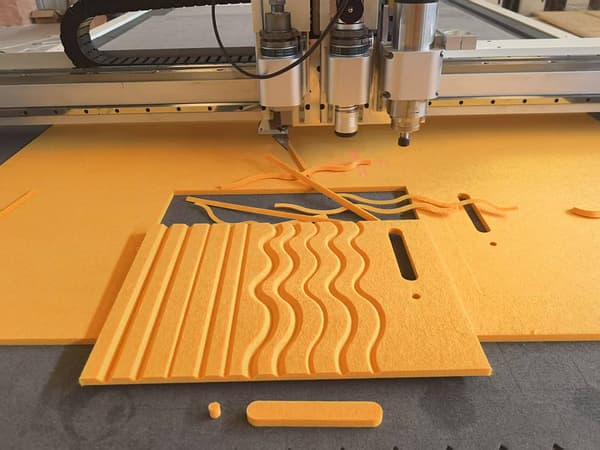
Different acoustic panel products require different processing methods. Some manufacturers mainly produce rectangular wall panels, while others make decorative panels with circles, curves, waves, and other irregular shapes.
Some products also require V-grooving or U-grooving for folding and special structural designs.
I believe that buyers should consider their current products and future orders together. A machine with flexible tool configurations can help manufacturers handle more product types without purchasing separate equipment for every process.
2. Why Is Material Fixation So Important for PET Acoustic Panel Cutting?
PET panels can move or shift during cutting when the fixation system is not suitable. This movement can cause inaccurate dimensions and uneven edges.
A reliable material fixation system helps maintain panel stability throughout the cutting process.

Why Can Traditional Vacuum Adsorption Be Insufficient?
Vacuum adsorption is a common method for fixing materials on CNC cutting machines. However, PET polyester fiber panels can have a relatively open and porous structure.
Air can pass through the material during vacuum adsorption. This condition can reduce the effective holding force, especially when the panel has high air permeability.
When the material is not held firmly, several problems may occur:
- The panel may move during cutting.
- Small shapes may shift from their original positions.
- Cutting dimensions may become inconsistent.
- Groove positions may not match the design.
- Operators may need to adjust the material manually.
I have seen that material fixation is often one of the most important issues that buyers overlook when comparing acoustic panel cutting machines.
How Does AMOR CNC’s Proprietary Secondary Film Covering System Help?
At AMOR CNC, we developed our own secondary film covering system to improve material fixation during the cutting process.
This system applies a film over the PET acoustic panel surface. The film helps reduce air leakage through the porous material and improves the effectiveness of vacuum adsorption.
The working principle is simple. The film helps create a more stable adsorption condition, so the machine can hold the panel more effectively during cutting.
This solution is especially useful for PET acoustic panels that are difficult to fix with conventional vacuum adsorption alone.
I recommend evaluating the system with your actual panel materials because the results depend on the material’s thickness, density, and air permeability.
The system can help address material movement, improve cutting stability, and support more consistent processing. For manufacturers who need to produce small decorative shapes and complex contours, stable material fixation is especially important.
3. Why Does Working Table Flatness Matter for Accurate Acoustic Panel Grooving?
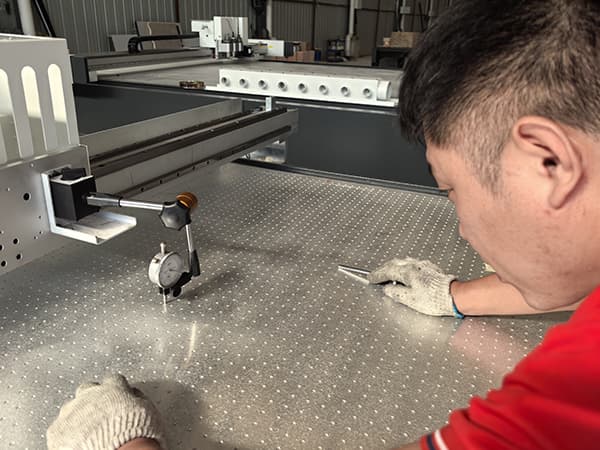
A CNC cutting machine may have advanced cutting tools, but an uneven working table can still affect the final result. This issue becomes more important when manufacturers need precise V-grooving or U-grooving.
A highly flat working table provides a stable reference surface and helps maintain consistent groove depth across the panel.
The Relationship Between Table Flatness and Groove Accuracy
When a PET acoustic panel is placed on the working table, the material should remain as flat and stable as possible.
If the working surface has uneven areas, the distance between the cutting tool and the material surface may change during processing. This change can affect groove depth and consistency.
For example, when a manufacturer needs to process a 20 mm PET panel with a specific V-groove depth, an uneven working surface may cause some areas to be cut deeper or shallower than others.
This problem can affect the folding result and the appearance of the finished product.
At AMOR CNC, we pay close attention to the flatness of the machine working table. Our goal is to provide a stable processing surface for accurate cutting and grooving.
How Can a Flat Working Table Reduce Material Waste?
Grooving accuracy affects more than the appearance of the finished panel. It can also affect material utilization.
If a groove is too deep, the panel may become damaged or lose the required structural strength. If the groove is too shallow, the panel may not fold correctly.
Both situations can lead to rejected products and additional material costs.
I believe that manufacturers should evaluate the working table and the grooving system together rather than looking only at the cutting tool.
The following table explains the relationship between common processing problems and their possible effects.
| Processing Issue | Possible Result | What to Check |
|---|---|---|
| Uneven working table | Inconsistent groove depth | Table flatness |
| Unstable material fixation | Position deviation | Vacuum and film system |
| Incorrect tool settings | Poor groove quality | Tool type and depth |
| Improper cutting parameters | Rough edges | Cutting speed and blade settings |
A stable and flat working table helps manufacturers achieve more consistent processing results and avoid unnecessary material waste.
4. Which Cutting Tools Are Needed for PET Acoustic Panel Manufacturing?
Different PET acoustic panel products require different cutting operations. A machine with suitable tool configurations can complete more processes and reduce the need for additional equipment.
I recommend choosing cutting tools according to your actual product designs rather than simply selecting as many tools as possible.

Electric Oscillating Knife for Precise Cutting
An electric oscillating knife uses a high-frequency reciprocating blade to cut materials. It is suitable for PET acoustic panel contour cutting and customized shapes.
Manufacturers can use this tool for straight lines, curves, circles, and irregular patterns.
The knife cuts the material mechanically without using high-temperature processing. This cold-cutting method helps avoid heat-related deformation and is suitable for many PET panel applications.
Pneumatic Oscillating Knife for Different Cutting Requirements
A pneumatic oscillating knife uses compressed air to drive the blade. It is another option for cutting different PET panel specifications.
The choice between electric and pneumatic oscillating knives depends on material thickness, density, cutting requirements, and production conditions.
I always suggest testing both the material and the tool configuration before confirming the final machine setup.
V-Grooving and U-Grooving for Special Panel Designs
Grooving is an important process in PET acoustic panel manufacturing.
V-grooving is commonly used when manufacturers need to create folding lines or special panel structures. U-grooving can be used for customized slot and groove designs.
The groove angle and depth should match the product drawing and material thickness.
Milling and Punching for Additional Processing
Some acoustic panel designs require circular holes, special openings, or additional milling operations.
A milling tool can process selected slots and holes, while a punching tool can produce suitable openings according to the tool specification.
| Tool Type | Main Application |
|---|---|
| Electric Oscillating Knife | Contour and shape cutting |
| Pneumatic Oscillating Knife | Cutting different PET panel specifications |
| V-Grooving Tool | V-shaped grooves and folding lines |
| Milling Cutter | Slots and special openings |
| Punching Tool | Suitable circular holes and openings |
I recommend a multi-tool configuration when your production involves several different processes. This setup can improve production flexibility and reduce manual operations.
5. How Can a CNC Acoustic Panel Cutting Machine Improve Production Efficiency?
Production efficiency depends on more than cutting speed. Material utilization, machine stability, software operation, and the number of processing steps all affect the final production cost.
A suitable CNC system can help manufacturers reduce manual work, optimize cutting layouts, and handle customized orders more efficiently.

Automatic Nesting Helps Reduce Material Waste
Automatic nesting software arranges different cutting patterns within the available material area.
The software can optimize the position and orientation of each design to improve material utilization.
For manufacturers who produce panels in different sizes and shapes, automatic nesting can help reduce unnecessary gaps between cutting patterns.
I believe this function is especially useful for factories that handle customized orders and small-batch production.
DXF File Import Makes Design Processing Easier
Most professional acoustic panel manufacturers use CAD software to prepare product drawings.
A CNC cutting machine should support commonly used design formats, such as DXF, so operators can import drawings directly into the cutting software.
At AMOR CNC, our cutting software supports DXF file importing and automatic nesting. Operators can prepare the design in CAD software and then generate the cutting path through the machine software.
This process helps reduce repeated manual drawing and makes it easier to switch between different product designs.
Multi-Tool Processing Improves Production Flexibility
When a factory needs to complete contour cutting, grooving, and hole processing, using separate machines for each process may increase handling time.
A multi-tool CNC cutting machine can combine different operations within one production system.
This setup can reduce manual material movement and make the production process more organized.
For manufacturers who want to expand their product range, I recommend considering the machine’s future tool expansion options before making a final decision.
6. How Should You Choose a Reliable Acoustic Panel Cutting Machine Manufacturer?
Choosing the right machine is important, but choosing the right manufacturer is equally important. A machine purchase is a long-term investment, and buyers need technical support after installation.
I recommend checking three important factors before placing an order: actual cutting tests, machine customization, and after-sales support.

Ask for Actual Material Cutting Tests
Product specifications and demonstration videos can help buyers understand machine functions. However, they cannot fully replace actual material testing.
I always encourage customers to send their PET acoustic panels and sample drawings for testing.
During the test, I suggest checking:
- Cutting accuracy and dimensional consistency.
- Cutting edge quality.
- Material fixation during processing.
- V-groove and U-groove depth consistency.
- Processing speed and overall results.
These tests can help buyers understand whether the machine meets their actual production requirements.
Check Whether the Machine Can Be Customized
Different factories have different production requirements.
Some manufacturers need a large working area for full-size PET panels. Others need special tool configurations for decorative shapes, grooves, and holes.
I believe that a good manufacturer should understand these requirements before recommending a machine.
Buyers should confirm the working area, maximum material thickness, tool configuration, vacuum system, and software functions.
The right configuration should match the actual production process. A higher-priced machine does not always mean a better solution for every factory.
Evaluate Technical Guidance and After-Sales Support
Machine installation is only the beginning of long-term cooperation.
Operators may need help with cutting parameters, tool maintenance, software operation, and new product designs after the machine arrives.
At AMOR CNC, we use our experience with different cutting applications to provide practical guidance to customers.
We can help customers evaluate material characteristics, select suitable tools, adjust cutting parameters, and understand different processing methods.
I believe that this practical experience is just as important as the machine itself. A reliable supplier should help customers solve real production problems, not simply deliver equipment and finish the transaction.
7. Why Choose AMOR CNC for Your PET Acoustic Panel Cutting Needs?
When I recommend an acoustic panel cutting machine, I focus on three things: stable material fixation, accurate processing, and long-term technical support.
These are also the areas where AMOR CNC has developed practical solutions for PET acoustic panel manufacturers.

Our Proprietary Secondary Film Covering System
AMOR CNC has independently developed a secondary film covering system to improve vacuum adsorption when processing porous PET acoustic panels.
The film helps reduce air leakage through the material and provides more stable fixation during cutting.
This solution helps address one of the common challenges in PET panel processing: keeping lightweight materials in position during cutting.
A Highly Flat Working Table for Accurate Grooving
We pay close attention to working table flatness because it directly affects processing stability.
A stable working surface helps maintain consistent tool-to-material positioning during grooving.
This is important for manufacturers who need accurate V-grooving, U-grooving, and other customized processing operations.
Our goal is to help customers reduce groove deviations, avoid unnecessary material waste, and achieve more consistent finished products.
Practical Guidance Based on Real Cutting Experience
At AMOR CNC, we understand that every customer has different materials, drawings, and production requirements.
Our experience with CNC oscillating knife cutting applications allows us to provide practical recommendations before and after machine delivery.
We can help customers evaluate sample materials, select suitable cutting tools, test processing parameters, and solve problems during daily operation.
We do not believe that recommending the most expensive configuration is always the right approach. We prefer to understand the customer’s actual production needs and recommend a suitable solution.
8. Conclusion: How Can You Make the Right Choice?
Choose an acoustic panel cutting machine with stable fixation, a flat working table, suitable cutting tools, and reliable technical support.Choose AMOR, trust AMOR—we will provide you with a high-quality cutting machine for acoustic panels, along with professional guidance and support.