跳到内容

Are you using the wrong cutting tool for your gasket materials? Poor tool selection can slow down production, damage cutting edges, and increase operating costs.
A pneumatic oscillating knife suits thin materials with moderate hardness and offers faster cutting. A 400W electric oscillating knife provides a smaller stroke and lower frequency for more controlled cutting. The right choice depends on material type, thickness, and cutting resistance.
At AMOR CNC, we offer both pneumatic and electric oscillating knife solutions for industrial gasket production. We know that different sealing materials require different cutting conditions. Rubber, non-asbestos sheets, PTFE, and graphite do not behave in the same way during cutting. A suitable tool can improve cutting quality and production efficiency.
But how do these two tools work? What are their main differences? And which one should you choose for your gasket manufacturing business? Let’s look at the technical details and practical applications.
1. What Are Pneumatic and Electric Oscillating Knives?
Are you sure that both oscillating knives work in the same way? Their drive systems and cutting movements are different.
A pneumatic oscillating knife uses compressed air and offers an 8 mm stroke at 8,000 oscillations per minute. A 400W electric oscillating knife uses a servo motor and provides a 5 mm stroke at 4,000 oscillations per minute.
How Does a Pneumatic Oscillating Knife Work?
A pneumatic oscillating knife uses compressed air to drive the blade in a rapid up-and-down movement. The blade cuts the material through continuous high-frequency oscillation.
Our pneumatic oscillating knife has the following main specifications:
- Drive system: Pneumatic
- Stroke: 8 mm
- Oscillation frequency: 8,000 times per minute
- Air supply: Compressed air from an air compressor
The 8 mm stroke and 8,000 oscillations per minute allow the blade to move quickly during cutting. This configuration works well for thin materials with moderate hardness. It is especially useful when manufacturers need fast cutting and continuous production.
However, a pneumatic knife needs a suitable air compressor. The air supply must remain stable during operation. Manufacturers should also consider the compressor’s capacity and the machine’s air consumption when planning their production line.
How Does a 400W Electric Oscillating Knife Work?
A 400W electric oscillating knife uses a servo motor to drive the blade. The motor controls the blade’s reciprocating movement and provides a stable cutting process.
Our 400W electric oscillating knife has the following specifications:
- Drive system: 400W servo motor
- Stroke: 5 mm
- Oscillation frequency: 4,000 times per minute
- Air supply: No compressed air required for the knife head
The electric knife has a smaller stroke and a lower oscillation frequency than the pneumatic knife. This configuration provides a different cutting movement and is suitable for applications that require more controlled blade movement.
The electric knife also removes the need for a separate pneumatic supply for the cutting head. This can simplify equipment setup and reduce dependence on compressed air.
What Are the Main Technical Differences?
The following table shows the main specifications of the two tools.
| Technical Parameter | Pneumatic Knife | 400W Electric Knife |
|---|---|---|
| Drive system | Compressed air | 400W servo motor |
| Stroke | 8 mm | 5 mm |
| Frequency | 8,000 times/min | 4,000 times/min |
| Air compressor | Required | Not required for knife head |
| Cutting movement | Larger stroke, higher frequency | Smaller stroke, lower frequency |
| Main application direction | Thin materials with moderate hardness | Materials requiring controlled cutting movement |
These specifications show that the two tools have different working characteristics. A higher oscillation frequency does not automatically mean better cutting quality. The final result also depends on material hardness, thickness, density, blade design, and cutting speed.
2. Which Gasket Materials Are Suitable for a Pneumatic Oscillating Knife?
Do your workers need to cut thin gasket sheets at high speed? A pneumatic oscillating knife can be a suitable option for these production tasks.
We generally recommend pneumatic oscillating knives for thin materials with moderate hardness. Their 8 mm stroke and 8,000 oscillations per minute support fast cutting and efficient processing.
Thin Rubber Gasket Sheets(1mm-5mm)
Rubber is one of the most common materials in gasket manufacturing. Different rubber types have different levels of hardness and elasticity.
Thin rubber sheets with moderate hardness are suitable applications for a pneumatic oscillating knife. Its high oscillation frequency helps the blade move through the material quickly.
However, rubber can stretch or deform during cutting. The material must remain stable on the vacuum table. The blade must also match the rubber’s thickness and hardness.
For very soft rubber, the material’s elasticity may affect the cutting edge. For harder or thicker rubber, we recommend testing both knife types before selecting the final configuration.
Thin Non-Asbestos Gasket Materials(1-5mm)
Non-asbestos gasket sheets are widely used in industrial sealing applications. These materials often contain fibers and fillers that affect their cutting resistance.
Thin non-asbestos sheets with moderate hardness can be processed with a pneumatic oscillating knife. The high-frequency movement supports fast cutting and helps manufacturers process repeated gasket patterns efficiently.
However, non-asbestos materials vary in density and composition. Some reinforced sheets may require different cutting conditions. We recommend checking the material structure before choosing the blade and cutting parameters.
When Should You Choose a Pneumatic Knife?
We recommend considering a pneumatic knife when your production mainly involves:
- Thin rubber gasket sheets with moderate hardness.
- Thin non-asbestos gasket materials.
- Materials that allow fast, high-frequency cutting.
- Repetitive gasket patterns that require efficient production.
The pneumatic knife is not automatically the best option for every thin material. Material flexibility, hardness, and blade resistance still affect the final cutting result.
3. Which Gasket Materials Are Suitable for a 400W Electric Oscillating Knife?
Are you processing gasket materials with higher cutting resistance? A 400W electric oscillating knife offers a different blade movement that may better match your requirements.
We recommend evaluating the electric knife for materials that need a more controlled cutting movement. Its 5 mm stroke and 4,000 oscillations per minute provide a smaller and slower reciprocating movement than the pneumatic knife.
Rubber Gasket Sheets with Higher Cutting Resistance
Rubber materials can vary greatly in hardness, density, and elasticity. Some rubber sheets create more resistance during cutting than thin, softer materials.
For these applications, we recommend testing the 400W electric oscillating knife. Its servo motor drive and smaller stroke provide a different cutting condition that may help achieve a suitable cutting result.
The actual performance depends on the rubber type, thickness, blade shape, and cutting speed. We should not select a knife based only on the material name.
PTFE Gasket Materials
PTFE is a common sealing material in chemical, mechanical, and industrial applications. It has a soft and flexible structure, and some PTFE sheets can deform during cutting.
When we process PTFE, we pay close attention to material fixation and blade movement. The 400W electric knife can be evaluated for applications where controlled blade movement is important.
However, PTFE has different grades and thicknesses. We recommend testing the actual material to check edge quality, dimensional accuracy, and deformation.
Graphite and Reinforced Gasket Materials
Flexible graphite is widely used in high-temperature sealing applications. Some graphite sheets have a fragile structure and can break or produce damaged edges if the cutting conditions are unsuitable.
Reinforced graphite and other composite gasket materials can also have different cutting resistance because of their internal structures.
We recommend testing the 400W electric knife when the application requires a more controlled cutting movement. The correct blade and cutting parameters remain important.
For graphite and reinforced materials, we do not recommend choosing a knife based only on its motor power or oscillation frequency. A material test provides more reliable information.
When Should You Choose a 400W Electric Knife?
We recommend evaluating a 400W electric oscillating knife for:
- Rubber sheets with higher cutting resistance.
- PTFE materials that require controlled cutting.
- Graphite sheets and reinforced gasket materials.
- Applications where a smaller blade stroke is preferred.
These are recommended testing directions rather than fixed material limitations. The actual knife selection should depend on material thickness, hardness, structure, and sample cutting results.
4. How Do Stroke and Oscillation Frequency Affect Gasket Cutting?
Do you think a higher oscillation frequency always produces a better cutting result? The relationship is more complex.
Stroke and oscillation frequency affect how the blade moves through the material. We need to consider both parameters when selecting a cutting tool for gasket production.
What Does Stroke Mean in Oscillating Knife Cutting?
Stroke refers to the distance of the blade’s reciprocating movement. A larger stroke creates a longer movement during each oscillation.
Our pneumatic knife has an 8 mm stroke, while our 400W electric knife has a 5 mm stroke.
The larger stroke of the pneumatic knife supports its high-frequency cutting movement. The smaller stroke of the electric knife provides a different movement pattern.
However, stroke alone does not determine the maximum cutting thickness. Blade length, blade geometry, material properties, and tool structure also affect the actual cutting depth.
How Does Oscillation Frequency Affect Cutting Speed?
Oscillation frequency describes how many times the blade moves back and forth within one minute.
Our pneumatic knife operates at 8,000 oscillations per minute. Our 400W electric knife operates at 4,000 oscillations per minute.
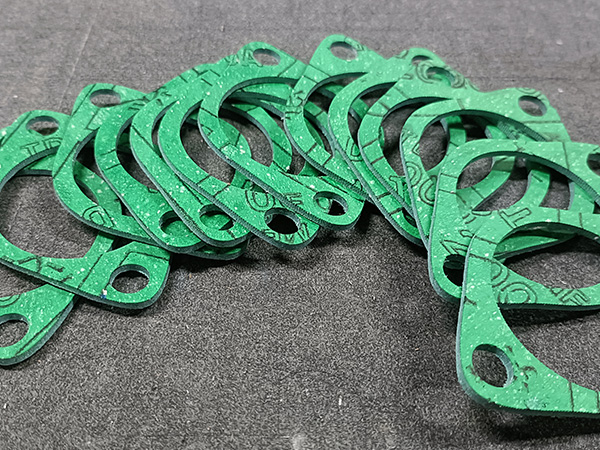
The pneumatic knife has a higher oscillation frequency. This makes it suitable for fast cutting applications involving thin materials with moderate hardness.
The electric knife has a lower frequency and a smaller stroke. It offers a different balance of blade movement for applications that need controlled cutting conditions.
We also need to consider the machine’s feed speed. A high oscillation frequency does not guarantee a faster production cycle if the material creates high cutting resistance.
Why Should You Consider Both Parameters?
We recommend evaluating stroke and frequency together. A knife with a larger stroke may perform well in one material but may not produce the best edge quality in another material.
The correct combination depends on the material’s physical properties and the required cutting result. We always recommend testing actual gasket samples before confirming the final knife configuration.
5. How Should You Choose a Knife Based on Gasket Material Thickness?
Are you choosing a knife only by looking at the material name? Thickness is another important factor.
The same material may require different cutting conditions at different thicknesses. We recommend checking material thickness together with hardness, density, and cutting resistance.
Thin Gasket Materials
Thin materials with moderate hardness are suitable candidates for pneumatic oscillating knives.
The 8 mm stroke and 8,000 oscillations per minute provide a fast cutting movement. This can help manufacturers improve productivity when processing repeated gasket patterns.
For very soft or flexible sheets, we also need to check whether the blade causes material movement or deformation during cutting.
Medium-Thickness Gasket Materials
Medium-thickness materials require more attention to blade length and cutting stability.
We recommend testing both knife types when the material has different levels of hardness or density. The pneumatic knife may offer a faster cutting movement for suitable materials. The electric knife may provide a more controlled movement for other applications.
The test should include complete cutting, edge quality, dimensional accuracy, and production speed.
Thick and High-Density Gasket Materials
Thick and high-density materials usually create greater demands on the cutting system.
We recommend checking the effective blade length, available cutting depth, blade strength, and material resistance before selecting a tool.
A 400W motor rating does not directly indicate the maximum material thickness. The actual cutting capacity must be confirmed through sample testing.
For thick rubber or reinforced gasket materials, we suggest sending samples to AMOR CNC. We can evaluate the cutting performance and recommend a suitable configuration.
6. Can One CNC Gasket Cutting Machine Use Both Pneumatic and Electric Knives?
Does your factory process different gasket materials every day? A single knife configuration may not meet all your production needs.
A CNC gasket cutting machine can be configured with different cutting tools. A combination of pneumatic and 400W electric oscillating knives can provide greater flexibility for manufacturers who process different materials.
Why Do Some Gasket Manufacturers Need Both Tools?
Many gasket manufacturers produce more than one type of sealing material.
One production order may involve thin rubber sheets. Another order may involve non-asbestos materials, PTFE, or graphite.
These materials have different physical properties. Their cutting resistance, elasticity, and thickness may also vary.
If a factory uses only one knife for every material, the operator may need to adjust the cutting parameters frequently. Some materials may also require a different cutting movement to achieve the desired result.
A dual-tool configuration gives manufacturers more options. Operators can select the appropriate tool according to the material and production requirements.
What Are the Advantages of a Dual-Tool Configuration?
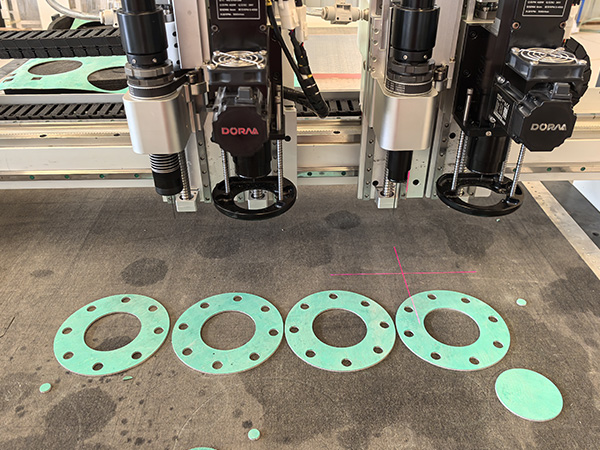
A machine equipped with both pneumatic and electric oscillating knives can offer several benefits:
- Greater material flexibility: Operators can select different knives for different gasket materials.
- More suitable cutting conditions: Each tool provides a different stroke and oscillation frequency.
- Better production planning: Manufacturers can arrange different materials according to their cutting requirements.
- Reduced tool selection limitations: One machine can support a wider range of production tasks.
However, a dual-tool configuration does not mean that every material can be processed perfectly without testing. The correct blade, cutting speed, and machine settings remain important.
How Can AMOR CNC Help You Select the Right Configuration?
At AMOR CNC, we do not recommend adding every available tool to a machine without understanding the customer’s production needs.
We first need to know which materials the customer processes, how thick the materials are, and what cutting quality the customer expects.
We then evaluate the suitable knife configuration through material testing.
This approach helps customers avoid unnecessary equipment costs and choose a machine that matches their actual production requirements.
7. What Else Should You Consider When Buying a CNC Gasket Cutting Machine?
Are you comparing CNC gasket cutting machines based only on their prices and cutting heads? Other machine features also affect production results.
We recommend checking the complete machine configuration before making a purchasing decision.
Working Area and Material Size
The working area should match the dimensions of your common gasket sheets.
A suitable working area allows operators to process standard material sizes without unnecessary repositioning. Manufacturers should also consider future production requirements.
Cutting Accuracy and Repeatability
Gasket products often require accurate dimensions and consistent cutting results.
We recommend asking the supplier about positioning accuracy, repeatability, and actual sample cutting performance.
You should also check whether the machine can maintain stable cutting quality during continuous production.
Vacuum Table and Material Fixation
Material fixation is important when cutting thin, flexible, or lightweight gasket sheets.
A suitable vacuum table helps hold the material in position during cutting. The vacuum system should match the material’s size, surface, and air permeability.
Automatic Nesting Software
Automatic nesting helps arrange different gasket patterns on the same sheet.
The software can generate a suitable cutting layout and reduce unnecessary gaps between patterns. This helps improve material utilization and reduce manual layout work.
Technical Support and Tool Selection
The supplier should understand the materials you process and provide suitable tool recommendations.
At AMOR CNC, we encourage customers to share material samples, thickness information, and CAD drawings before confirming the final configuration.
This allows us to evaluate the cutting requirements and provide a more suitable CNC gasket cutting solution.
8. Why Choose AMOR CNC for Gasket Cutting?
Are you looking for a CNC cutting machine that can handle different gasket materials with suitable tool configurations? We focus on providing practical cutting solutions for industrial gasket manufacturers.
AMOR CNC offers CNC gasket cutting machines with pneumatic and 400W electric oscillating knife options. We help customers select the right configuration according to their materials and production requirements.
Pneumatic Oscillating Knife for Fast Cutting
Our pneumatic oscillating knife features an 8 mm stroke and an oscillation frequency of 8,000 times per minute.
It is suitable for thin materials with moderate hardness. It also provides a fast cutting movement for production tasks that require efficient processing.
This tool requires a suitable compressed air supply.
400W Electric Oscillating Knife for Controlled Cutting
Our 400W electric oscillating knife uses a servo motor drive. It has a 5 mm stroke and an oscillation frequency of 4,000 times per minute.
Its smaller stroke and lower frequency provide a different cutting movement. We recommend evaluating it for gasket materials that require more controlled blade movement.
The electric knife does not require a separate compressed air supply for the knife head.
Customized Tool Configuration for Different Materials
Every gasket manufacturer has different production requirements.
Some factories mainly process thin rubber sheets. Others work with non-asbestos, PTFE, graphite, and thicker sealing materials.
We provide tool recommendations based on material type, thickness, hardness, and sample cutting results.
Our goal is to help customers choose the right CNC gasket cutting machine without paying for unnecessary configurations.
Conclusion: Which Oscillating Knife Should You Choose for Gasket Cutting?
The pneumatic knife is a strong choice for fast cutting of thin materials with moderate hardness. The 400W electric knife offers a smaller stroke and lower frequency for more controlled cutting applications.
Neither knife is suitable for every gasket material. The best choice depends on your material properties, thickness, and production requirements.
At AMOR CNC, we help gasket manufacturers evaluate their materials and select the right cutting tool. Send us your material samples, thickness details, and cutting drawings. Our team will help you find a suitable CNC gasket cutting solution for your business.