
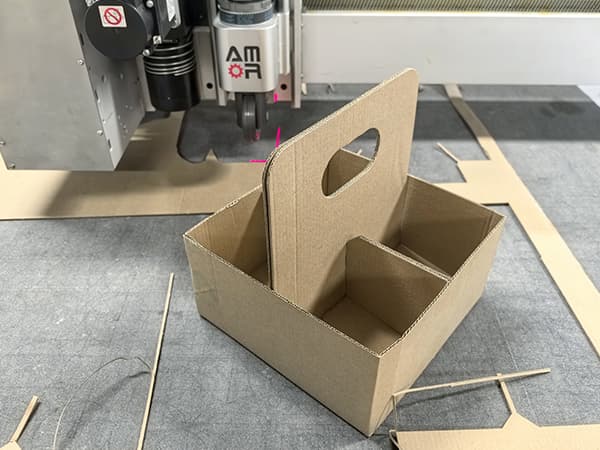
Die quotes look cheap—until deadlines slip, revisions pile up, and “one small change” becomes a full reset.
A CNC oscillating knife wins when orders are custom, short-run, and frequently revised, because it removes die lead time, reduces rework risk, and shortens approval cycles.
I will start with order types and numbers, then I will show where the “no mold” workflow saves time and money. If you only want the conclusion, stop now. If you want to avoid expensive packaging mistakes, keep reading.
What actually drives cost and lead time in corrugated boxes?
Die-cutting feels fast, but the die is the real schedule gate.
A CNC oscillating knife table becomes faster overall when design changes are common, because the “tooling step” becomes a file update instead of a new die.
The three cost buckets that decide everything
I always break packaging cost into three buckets. I do not mix them, because mixing hides problems.
- Tooling cost (die cost, die maintenance, die storage, die remake)
- Setup cost (make-ready, registration, trial cuts, first-article approval)
- Unit cost (material, cutting speed, scrap, labor)
When a buyer compares suppliers, the mistake is simple: many people only compare unit cost, because it is easy. Procurement teams like easy numbers. But custom packaging is rarely a pure unit-cost game. The real cost sits in tooling + setup + rework.
Here is a basic comparison that my customers understand in one minute:
| Item | Die-Cutting | CNC Oscillating Knife + Creasing |
|---|---|---|
| New design start | Needs a die | Needs a CAD file |
| Revision frequency | Expensive | Low-cost |
| Lead time risk | High (die lead time) | Low (digital) |
| Best for | Stable high volume | Short runs / multi-SKU |
| Approval cycles | Longer | Shorter |
A simple “time gate” chart you can show your boss
When a project is urgent, the gate is not the cutting speed. The gate is the “tooling + approval” loop.
Lead time gates (typical decision logic)
Die-cutting: Design → Die order → Die delivery → Trial → Fix → Production
CNC: Design → Trial → Production
A quick visual:
Time gates (relative)
- Die order: 🟥🟥🟥🟥🟥
- Trial + revision: 🟥🟥🟥
- CNC file update: 🟩
If your customer changes the box size, insert layout, or opening style twice, the die route gets painful. The CNC route stays calm.
Which order types are “made” for no-mold cutting?
One custom request can destroy a die-based schedule.
No-mold cutting fits orders where the design is not stable, because the machine follows a file, not a metal tool.
I use a “revision probability” filter
When a buyer asks me which process to choose, I ask one question first:
“How likely is your customer to change the design after they see the first sample?”
If the probability is high, die-cutting becomes risky. If the probability is low and volume is high, die-cutting can be perfect.
Here is a practical order-fit table:
| Order Type | Design Changes? | Volume per SKU | Best Fit |
|---|---|---|---|
| E-commerce brand seasonal boxes | High | Low–Medium | CNC first |
| Startup product packaging | Very high | Low | CNC |
| Agency-driven marketing packs | High | Low | CNC |
| Stable retail box (12+ months) | Low | High | Die-cutting |
| Multi-SKU inserts (many sizes) | High | Low | CNC |
| Urgent replacement orders | Medium | Low–Medium | CNC |
The hidden risk: “approval loop cost”
I have seen a simple story repeat many times. A brand wants a premium corrugated box. The team approves the design on screen. The first physical sample shows a folding issue. Then the team adjusts a crease position by a few millimeters. If the factory already ordered a die, that “few millimeters” becomes a real cost event.
With CNC, a change like that is usually a file update + another sample. The risk stays small. That is why I call CNC the “insurance policy” for custom packaging.
A simple rule I use
I keep the rule simple so that procurement can apply it fast:
- If SKU count is high and volume per SKU is low, I prefer CNC.
- If design is stable and volume is high, I prefer die-cutting.
- If lead time is urgent, I start with CNC for validation, then I move to die-cutting later if needed.
This hybrid path is often the most rational way to buy time.
Where does digital cutting reduce setup time and rework risk?
People say “CNC is flexible,” but flexibility is not the real point.
Digital cutting reduces setup time because it removes die handling, and it reduces rework because changes do not restart the tooling cycle.
### Setup time is not only machine time
Many factories track setup as “minutes at the machine.” I track setup as everything before stable production.
In corrugated packaging, stable production needs:
- correct fold lines,
- correct crease depth (not cracking, not spring-back),
- correct slot positions,
- correct closure geometry,
- and clean cutting edges.
Die-cutting can be extremely fast after setup, but the first setup can include:
- die installation,
- pressure adjustments,
- test sheets,
- alignment and trial,
- and sometimes die correction.
Digital cutting usually needs:
- file confirmation,
- tool selection (knife + creasing wheel or V-cut),
- and test pieces.
If the file is ready, the path is shorter.
### Rework risk is about “change cost,” not “defect rate”
I do not claim die-cutting creates more defects. A good die shop can do excellent work. The real difference is the cost of change.
Let’s use a simple example that happens often:
- The box design changes twice after the first sample.
- Each change updates fold lines and tabs.
In a die workflow, change cost can include die modification or a new die. In a CNC workflow, change cost is usually a file edit. So the “risk cost” is lower.
Here is a simple “change impact” bar chart:
Cost impact of 1 design change
- Die-cutting: ██████████
- CNC cutting: ███
I am not giving a universal price. I am giving a decision pattern. For custom work, change cost decides profit.
How do creasing, V-grooving, and cutting work together?
A clean box depends on crease quality, not only cutting speed.
A CNC oscillating knife solution wins when it can crease or V-groove first, then cut, because folds become consistent across revisions.
### Why creasing matters more than most buyers think
I often tell buyers this: the knife makes the shape, but the crease makes the box.
If the crease is wrong, you will see:
- cracked liner paper at the fold,
- poor corner squareness,
- inconsistent box height,
- and slow assembly speed.
In many workshops, operators “fight the fold” using hand pressure or tape. That is not a production plan.
For corrugated and carton structures, I normally apply this logic:
- Creasing wheel for thin carton board and common corrugated grades where a pressed crease works well.
- V-grooving for thicker or special board structures when you need controlled folding geometry.
This is not about hype. This is about predictable folding.
### Practical workflow that reduces mistakes
I like a two-step sequence:
- Crease / V-groove first (define folds)
- Cut second (define outline)
That order reduces tearing at corners, because the board still has its full structure during creasing.
A simple operator checklist I use:
- I confirm board thickness and flute type.
- I confirm crease line direction relative to flute.
- I run a small sample at low speed.
- I check fold angle and corner tightness.
- I adjust crease depth and repeat once.
This process saves time because it prevents “mass rework.” Rework is always slower than careful sampling.
### One small “rational buyer” note
If a buyer only asks for cutting speed, I know the buyer will face issues later. A rational buyer asks:
- “How stable are the folds across different box sizes?”
- “How fast can we change a design and re-run?”
- “How do we control crease depth and consistency?”
Those questions protect profit.
When should you still choose die-cutting—and when should you switch?
Some buyers want one answer for every case.
A rational approach is hybrid: validate and iterate with CNC, then move to die-cutting only when the design is stable and volume is proven.
### A clean decision map I use with procurement teams
I do not argue with die-cutting. I use it when it matches the order.
Here is my decision map:
Choose CNC first when:
- The customer is still confirming size and structure.
- The order has many SKUs.
- The lead time is tight.
- The design team changes artwork or openings often.
- You need prototypes, samples, or pilot runs.
Choose die-cutting when:
- The design will stay stable for months.
- The order is high volume per SKU.
- You want the lowest unit cost at scale.
- You can forecast demand accurately.
### A simple volume chart you can show internally
I use this as a simple visual discussion tool. It is not a promise. It is a logic tool.
Best-fit by volume per SKU (illustrative)
Low volume: 🟩 CNC advantage
Medium volume: 🟨 depends on revision frequency
High volume: 🟥 die advantage
- 0–500 pcs/SKU: 🟩🟩🟩
- 500–5,000 pcs/SKU: 🟨🟨🟨
- 5,000+ pcs/SKU: 🟥🟥🟥
If revision frequency stays high, CNC keeps winning even as volume grows.
### My personal “cost honesty” note
I never tell a buyer that CNC replaces die-cutting forever. That is not honest. Die-cutting exists for a reason. But I do tell buyers this:
If you run custom packaging, you do not need one process. You need the right process at the right stage.
A CNC oscillating knife table is a strong tool for the stage where decisions are still moving. That stage is where delays and mistakes are most expensive.
Conclusion
No-mold CNC wins on custom, short-run, and fast-changing box orders because it cuts lead-time gates and reduces the cost of change.