跳到内容
跳到内容 
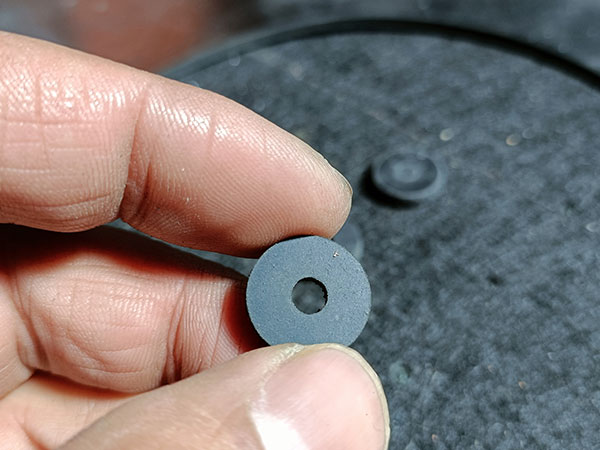
Bad accuracy ruins good gasket material.
A good CNC gasket cutting machine can reach high repeatability, clean edge quality, and stable hole position, but the final result depends on servo control, frame rigidity, vacuum hold-down, table flatness, blade choice, and machine assembly accuracy.

If you are buying a CNC gasket cutting machine, I suggest you stop looking at speed first. I suggest you look at accuracy first. In gasket production, speed is useful, but sealing performance depends more on whether every finished part is the right size, whether every bolt hole lands in the right place, and whether every edge is smooth enough to seal well. A machine may cut fast and still fail in real production. That is why precision is one of the most common questions buyers ask me.
What Does Accuracy Really Mean in Gasket Production?
A neat sample does not prove real accuracy.
In gasket cutting, accuracy means more than one size number. It means repeatability, circle closure, bolt-hole alignment, edge smoothness, and stable results across many parts and many batches.

When many buyers ask about accuracy, they usually ask one simple question: what is the machine tolerance? That is a fair question, but it is too narrow. In real gasket production, I do not judge accuracy by one data point alone. I judge it by whether the machine can cut the same part again and again with the same result. I also judge it by whether a round gasket closes perfectly, whether bolt holes line up during installation, and whether the edge remains smooth enough to support sealing pressure.
Why repeatability matters more than one perfect sample
A single sample can look very good. That does not prove stable production. I care more about the tenth piece, the fiftieth piece, and the next batch next week. In many supplier comparisons, buyers often see repeat accuracy figures of ≤0.1 mm, and some pages mention product error around ±0.03 mm under controlled conditions. Those numbers are useful, but only when the machine can hold them over time and across different gasket shapes.
Why circle closure is a real test
Many gasket parts include inner circles, outer circles, and small radius corners. If the start point and end point do not close well, the part may still look acceptable from far away, but it is not truly accurate. A small opening or overlap at the joint point can create fitting problems and may affect sealing in real use.
Why hole position matters as much as outer size
A gasket with a correct outer diameter but poor bolt-hole position is still a bad gasket. In real assembly, hole offset causes installation trouble first. So when I judge a CNC gasket cutting machine, I always look at part size and hole alignment together.
| Accuracy Item | Why It Matters | What I Check |
|---|---|---|
| Repeatability | Stable mass production | Same part cut many times |
| Circle closure | True geometric accuracy | Start-end point consistency |
| Bolt-hole alignment | Easy installation | Hole spacing and position |
| Edge smoothness | Better sealing effect | Burrs, tearing, roughness |
| Batch stability | Reliable output | Results across many sheets |
How Accurate Can a CNC Gasket Cutting Machine Really Be?
Numbers look good. Structure proves them.
A well-built CNC gasket cutting machine can reach repeatability around ≤0.1 mm, and under good assembly and material conditions, some finished-part deviations can stay around ±0.03 mm. The key is whether the machine structure can hold that accuracy in real production.

I think buyers should be careful here. Many machines show attractive numbers in brochures. I do not reject those numbers, but I always ask a second question: under what condition? A machine can show a nice result on a simple sample, thin material, or short run. That does not mean it will hold the same quality on dense graphite sheets, reinforced gasket material, or long working hours. So I like to separate claimed accuracy from usable accuracy.
Claimed accuracy and usable accuracy are not always the same
Claimed accuracy usually comes from ideal test conditions. Usable accuracy comes from factory reality. Factory reality includes machine vibration, table flatness, blade wear, suction stability, dense material resistance, and long production hours. A strong machine should not only show a good number. It should keep that number close in daily work.
I focus on production-level accuracy
In actual gasket production, I care about these questions:
- Can the machine cut 20 pieces with the same hole position?
- Can the machine keep clean closure on circles?
- Can the machine hold the same size on the left side and right side of the table?
- Can the machine keep accuracy after long running?
These questions matter more than a single tolerance number. That is why AMOR CNC focuses not only on software settings, but also on machine structure and installation accuracy.
Why assembly accuracy supports cutting accuracy
At AMOR CNC, the mounting surfaces for all rails and racks are machined and milled flat, with machining accuracy at 0.03 mm. This point matters a lot. If the mounting face is not flat, the rail alignment changes. Then motion stability changes. Then final cutting accuracy changes too. Buyers often see only the outside of the machine, but this hidden machining work is one of the real foundations of precision.
Brochure number           ████████
Real production accuracy  ███████
Stable long-run accuracy  ██████
Key support: structure + assembly + motion control
What Machine Factors Affect Final Edge Quality the Most?
A sharp blade alone cannot save a weak machine.
Final edge quality depends on several linked factors, including servo motor control, frame rigidity, vacuum adsorption, table flatness, blade selection, and correct parameter matching between tool and material.
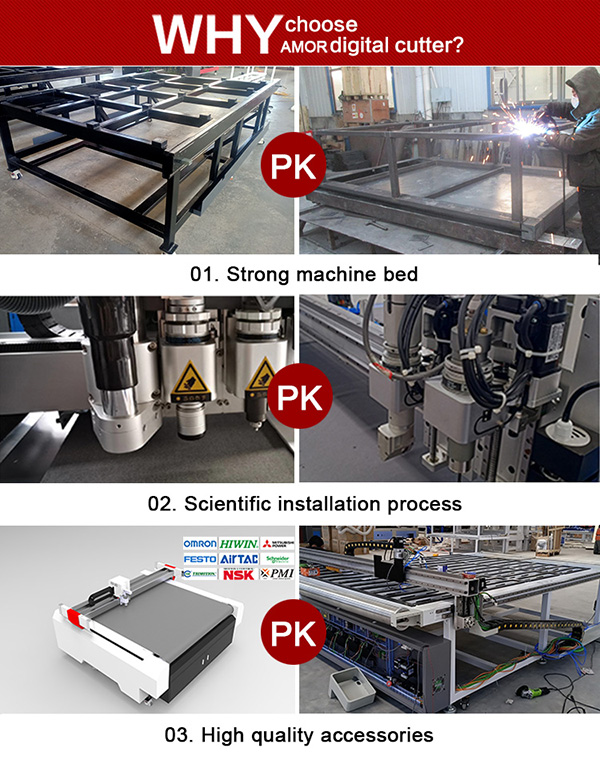
When a customer sends me a photo of a rough gasket edge, I do not blame the blade first. I check the whole system. Edge quality is the final result of motion, force, support, and blade behavior working together. If one part of this chain is weak, the cut edge shows the problem quickly.
Servo control affects path stability
The cutting head must follow the drawing path smoothly and precisely. If motion response is weak, corners may overcut, circles may not close well, and hole positions may drift slightly. AMOR CNC uses Mitsubishi servo motors with helical gear reducers, and the Y-axis uses dual servo motor drive. This gives strong power and stable motion. It also helps the machine stay smooth during fast direction changes.
Vacuum hold-down affects part movement
Many buyers think vacuum is only for holding the sheet in place. That is true, but it is not the full story. Vacuum adsorption also affects edge quality. If the material shifts slightly during cutting, even a good servo system cannot save the result. This is especially important for thin rubber, PTFE, and soft gasket sheets.
Blade and parameter match affect the cut face directly
The blade touches the material directly. Blade thickness, sharpness, angle, and exposure all affect the cut face. But I never separate blade choice from machine support. A good blade on a vibrating machine still gives poor results. A strong machine with the wrong blade also gives poor results. So blade choice must match material hardness, thickness, and fiber structure.
Why Does Servo Motor Quality Matter So Much in Gasket Cutting?
Weak drive creates hidden errors.
Servo quality matters because gasket cutting needs precise path tracking, strong acceleration control, and smooth deceleration. A better servo system improves circle closure, hole position, and edge consistency, especially on dense or complex gasket shapes.
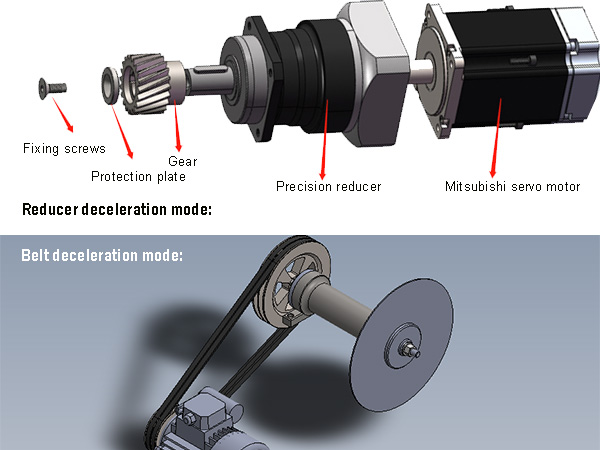
I think many buyers underestimate the drive system because they cannot see it working clearly from the outside. But the drive system is one of the first things I check. A CNC gasket cutting machine is constantly starting, stopping, turning, and correcting direction. This is especially true when the gasket design includes many holes, arcs, and tight corners. If the drive system is weak, the machine will still move, but the path quality will drop.
Why servo response affects small shapes
Small bolt holes and small inner circles are a good test for servo response. These features need fast but controlled motion. The machine must accelerate and slow down without shaking the head or dragging the blade. Better servo control helps the machine follow the path more faithfully.
Why dual drive matters on larger motion axes
AMOR CNC uses a dual servo motor drive on the Y-axis. I value this design because it improves balance and driving force on the longer movement side. It helps reduce twisting and supports smoother travel, especially when cutting at speed or processing larger sheets. Stable travel supports stable edge quality.
Why helical gear reducers help
The use of helical gear reducers is also important. They help deliver power more smoothly and support more stable transmission. In practical cutting, this helps reduce vibration and improve motion consistency. Buyers may not ask about reducers first, but they should. Motion quality is never only about the motor brand. It is about the whole transmission system.
Why Does Frame Rigidity Affect Accuracy After Long Running?
A weak frame becomes a slow problem, then a big one.
Frame rigidity matters because long-term cutting force and fast movement can cause vibration, deformation, and accuracy drift. A stronger machine bed supports stable cutting quality over time and reduces shaking during fast processing.

This is one of my strongest views when I compare machines. Many machines look similar in photos. Their outer shape may be close. Their bed size may be close. But their real rigidity is not the same. In gasket cutting, especially with dense materials like graphite, non-asbestos sheets, and reinforced gasket boards, the frame receives real cutting resistance again and again. Over time, a weak bed starts to show its weakness.
Why a strong bed matters during fast cutting
During fast cutting, the machine changes direction often. If the bed is not rigid enough, vibration increases. That vibration affects path tracking and edge finish. At first, the problem may look small. Later, it becomes more obvious in circle closure, hole position, and side-to-side consistency.
Why long-term deformation matters
Some buyers only inspect the machine when it is new. I think that is not enough. The real question is whether the machine stays stable after long running. AMOR CNC uses a super-strong machine bed to avoid deformation from long-term use and to reduce machine shaking during high-speed cutting. That is not just a selling point. It is a practical foundation for keeping accuracy over time.
Why rigidity supports sealing quality indirectly
A rigid frame does not touch the gasket directly, but it still affects sealing quality. That is because rigidity supports motion stability, and motion stability supports cut quality. In gasket production, these links are connected. The final part tells the truth.
Weak bed under speed      ████
Strong bed under speed    █████████Vibration risk            High → Low
Long-run stability        Low  → High
How Do Table Flatness and Rail Installation Affect Precision?
A flat table supports a true cut.
Table flatness and rail installation accuracy directly affect tool height consistency, motion alignment, and sheet support. If these surfaces are not precise, even a strong motor system cannot fully protect final cutting accuracy.

I often say that cutting accuracy begins before the tool even moves. It begins with how the machine is built. If the working table is not flat, the sheet support changes. If the rail installation face is not machined well, the motion path changes. If the rack mounting face is uneven, transmission stability changes. All of these small errors add together.
Why flatness affects tool depth consistency
Even in through-cutting work, flatness matters. If the support surface changes, the blade may penetrate differently across the table. This can affect edge smoothness and bottom cut consistency. On some materials, this also changes how cleanly the edge separates.
Why machined rail faces matter
AMOR CNC machines all rail and rack mounting surfaces by milling and leveling, with processing accuracy at 0.03 mm. I consider this one of the most valuable technical details in the machine. It creates a more accurate base for rail installation. Better rail installation supports better straightness and smoother motion.
Why buyers should ask about hidden machining
Many buyers ask about motors, blades, and table size. Fewer buyers ask whether the mounting surfaces are machined. I think that should change. Hidden machining quality is often one of the clearest differences between high-quality machines and cheap look-alike machines.
How Can Buyers Judge Accuracy Before Buying a CNC Gasket Cutting Machine?
Do not trust words alone. Test the right details.
Before buying, buyers should check repeat cuts, circle closure, bolt-hole alignment, edge smoothness, and left-to-right consistency on their real gasket materials. These tests show far more than a brochure tolerance claim.
I always recommend practical testing. A real buying decision should not rely only on photos, videos, or a single nice sample. Gasket production is too detail-sensitive for that. I want to see how the machine behaves on the actual material, actual thickness, and actual shape that the customer will produce.
What I would test first
I would test:
- the same part cut at least 10 times
- one gasket with small bolt holes
- one gasket with large circles
- one gasket with narrow bridges
- parts placed at different table positions
These tests show repeatability, closure, hole alignment, and platform consistency.
What I would inspect on the sample
I would inspect:
- whether the edge is smooth
- whether the holes align with the drawing
- whether the start and end point of the circle match
- whether size stays stable across repeated parts
- whether the machine behaves the same at different speeds
Why AMOR CNC is stronger in these tests
AMOR CNC’s advantages in these checks come from its real structure: Mitsubishi servo motors, helical gear reducer drive, dual-servo Y-axis, super-strong bed, and 0.03 mm machined rail and rack mounting surfaces. These details help the machine do more than cut a good demo. They help it keep good cutting quality in real production.
Choose precision you can repeat, not just precision you can quote.